

Blog
How to Choose the Perfect Wedding Backdrop for Your Venue in DFW

Every couple spends time choosing the right wedding backdrop. Most end up with one of two regrets: they picked something that looked stunning in a photo but felt wrong in the actual room, or they left the decision too late and chose from whatever was available. The backdrop is the background for your vows, your portraits, and every photograph your family takes that night. Getting it right matters.
This guide covers what standard wedding backdrop articles skip: what your specific DFW venue changes about the decision, how South Asian outfit colors affect your backdrop choice in ways Western guides never mention, and the one question most couples forget to ask before committing to a design.
Start with your venue (ceiling height, wall color, access window). Then match the backdrop size and material to the space. Then coordinate with your outfit palette. Then confirm the lighting plan. In that order. Changing the order is where most backdrop decisions go wrong.
Step 1: Start With Your Venue, Not Your Pinterest Board
The most common backdrop mistake is falling in love with an image before checking whether it can work in the actual venue. A wedding backdrop that looks grand in a 30-foot ballroom will look lost in a low-ceilinged banquet hall. One that suits a garden estate will topple in the Texas afternoon wind.
Before you look at a single inspiration photo, answer these four venue questions:
- What is the ceiling height? DFW hotel ballrooms typically range from 12 to 20 feet. Your backdrop height should not exceed the ceiling, and tall structures need extra anchoring.
- What is the wall color and material? A white floral backdrop against a cream wall disappears. A dark jaali panel against a dark wall does the same. The wedding backdrop needs enough contrast with its surroundings to read clearly in photographs.
- What is the setup window? Most DFW venues allow two to four hours for setup. A complex floral wall takes longer than a fabric drape. Confirm the window before committing to a design that needs six hours to build.
- Does the venue restrict anything? Many DFW ballrooms and hotel venues restrict open flame, ceiling rigging, and wall attachments. A freestanding backdrop on a weighted frame is often your only option.
Wind is the factor every outdoor backdrop plan underestimates. Lightweight fabric catches the afternoon Texas breeze, and a tall, top-heavy structure can lean or shift mid-ceremony. Use weighted bases, low-profile designs, and install as close to the start time as the venue allows.
Step 2: Match the Backdrop Size to the Room
Size is the decision most guides treat as an afterthought. It is actually one of the first things your photographer and your guests will notice.
Too small: A backdrop that is narrower than the couple’s seating area disappears in wide-angle shots and makes the stage feel unfinished. Aim for a width that extends at least two feet beyond the seated couple on each side.
Too large: An oversized backdrop in a small venue crowds the space and makes photos feel claustrophobic. In a private dining room or intimate banquet hall, a scaled, elegant backdrop reads better than a grand installation.
The proportion rule: The backdrop should occupy roughly 40 to 50 percent of the wall width behind the couple. Wider than that and it dominates the room. Narrower than that and it reads as an accessory rather than a focal point.
Step 3: Choose Your Backdrop Style
Once you know what your venue can support, the style decision becomes much clearer. Here are the main backdrop types and what each one actually suits.
Full Floral Wall
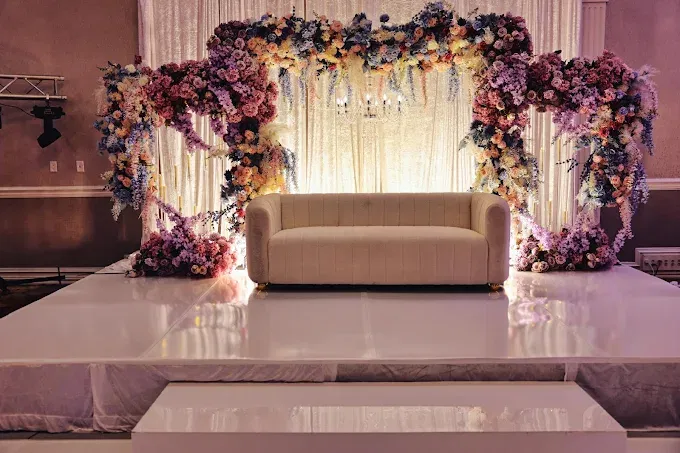
The most visually impactful wedding backdrop and the most photographed. A full floral wall reads beautifully from every angle and works at any scale. It is also the most expensive option and the most time-consuming to install. For a Pakistani or Indian wedding, a floral wall in the right palette can carry the entire room visually, which is why it is the most requested backdrop for Barat and reception events.
Fabric Drape Backdrop
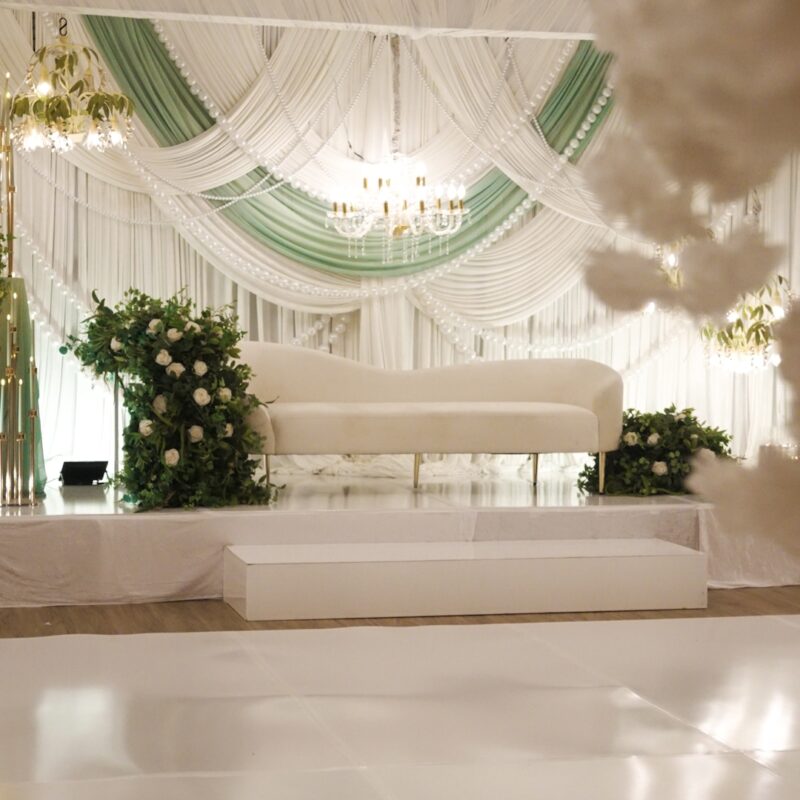
Fabric is the most versatile backdrop option across every venue type. Chiffon and organza drape softly and photograph well in both natural and artificial light. Heavier velvet reads luxurious and dramatic. A layered fabric backdrop with warm uplighting behind it is one of the most cost-effective ways to create a genuinely beautiful stage backdrop without a full floral build.
Jaali and Carved Panel Backdrop
Carved jaali panels with warm backlighting create a distinctively South Asian backdrop that no Western competitor designs for. The lattice pattern casts beautiful light across the stage and reads as genuinely cultural rather than generically decorative. This is the backdrop no generic guide covers, and it is one of the most requested designs for Pakistani and Muslim celebrations in DFW.
Geometric and Frame Backdrop
Gold hexagons, circles, and geometric frames create a modern, editorial look that works well for contemporary couples who prefer clean lines over florals. Decorate with asymmetrical corner clusters rather than covering the whole frame, since negative space is part of the design.
Illuminated and LED Backdrop
An illuminated backdrop with backlit panels, fairy lights, or LED installations creates warmth and drama for evening and indoor ceremonies. For DFW ballrooms with low ambient lighting, an illuminated backdrop often does more visual work per dollar than any floral option.
Step 4: Coordinate With Your Outfit Colors
This is the step every generic backdrop guide misses and the one that creates the most regrets in photographs. The backdrop color you choose directly affects how your outfit looks in every photo taken in front of it.
For South Asian bridal outfits: a deep red or maroon lehenga needs a backdrop that does not compete with it. Ivory, champagne, gold, or a deep jewel tone in a contrasting color all work. A red backdrop behind a red lehenga makes the bride disappear into the wall.
For Pakistani bridal wear: heavy embroidery and dupatta detail photograph best against a backdrop with a simpler texture. A full floral wall or a fabric drape in a complementary tone lets the outfit detail carry the image rather than fighting with the background.
For Western white gowns: avoid pure white or very light cream backdrops since the dress and the background blend in photographs. A soft champagne, blush, sage, or jewel-toned backdrop creates the contrast that makes a white dress pop.
For the groom’s sherwani or suit: coordinate the backdrop with the more visually complex outfit of the two. The backdrop should serve the couple as a pair, not just the bride.
The easiest way to check backdrop-outfit coordination is to hold a fabric swatch or an inspiration image of the backdrop next to a photo of the outfit in the same lighting. If they blend, make one darker or lighter.
Step 5: Plan the Lighting Before You Finalize Anything
Lighting changes everything about how a backdrop looks, and it is the factor most couples do not check until the day of the event.
Natural light: A backdrop placed in front of a window with afternoon Texas sun behind it will be backlit, silhouetting the couple and washing out backdrop detail. Position the backdrop so the natural light falls on the couple and the backdrop, not behind them.
Uplighting: Warm uplighting on a fabric backdrop transforms it from a plain drape into a glowing, intentional environment. Most DFW venue setups can accommodate uplighting, and it is one of the highest-value investments relative to its cost.
Pin spotting: A narrow spot aimed at the backdrop from above highlights texture and depth in a way that ambient room lighting cannot. For full floral walls and jaali panels, pin spotting is the difference between a backdrop that reads as flat and one that has dimension in photographs.
Flash and camera settings: Confirm with your photographer before the event how they plan to shoot the backdrop. A highly reflective sequin or shimmer backdrop needs different camera settings than a matte fabric one, and a professional photographer will adjust. An inexperienced one will not.
Step 6: The Repurpose Question Most Couples Forget
The single most cost-effective backdrop decision you can make is designing it to serve two functions: the ceremony and the reception.
A ceremony arch or backdrop can move behind the sweetheart table or cake table at the reception with a few adjustments. This means one design cost for two focal points, and it also creates a visual thread between the ceremony and reception that guests notice even if they cannot articulate why.
For this to work, the backdrop structure needs to be freestanding and movable. Confirm this before finalizing the design, since a backdrop built into a wall or rigged to a ceiling cannot be repositioned.
Step 7: South Asian Backdrop Considerations for DFW Weddings
Pakistani, Indian, and Muslim weddings in DFW carry specific backdrop requirements that no generic guide addresses. Here is what to know if you are planning a multi-function South Asian wedding.
Each function needs a different backdrop: The Mehndi backdrop is colorful, layered, and festival-inspired. The Nikkah backdrop is refined and serene. The Barat and reception backdrops are the grandest. Treating them as one shared decision is where multi-function backdrop planning goes wrong.
Cultural color palettes carry meaning: Red and gold for Pakistani receptions, marigold and jewel tones for Indian Mehndi, white and ivory for Nikkah. These aren’t just aesthetic choices; they are cultural signals guests read immediately.
The mandap is a backdrop in itself: For Hindu ceremonies, the mandap structure is the focal point and should be designed first. Any additional backdrop or floral framing behind it should support the mandap, not compete with it.
Jaali and carved panel backdrops are the differentiator: No Western competitor designs or recommends these, yet they are among the most visually distinctive backdrop options for Pakistani and Muslim celebrations. If you want a backdrop that is genuinely yours and not taken from a shared template, start here.
Questions to Ask Your Decorator Before Committing to a Backdrop
Before signing off on a backdrop design, get clear answers to these six questions:
- Can I see this backdrop installed in a venue similar to mine, not just in a studio or outdoor shoot?
- How does it photograph under venue lighting, not just in natural light?
- Can it be repurposed from the ceremony to the reception, and is the frame freestanding?
- What is the installation time, and does it fit within the venue’s setup window? Does the palette work with my
- outfit colors, and can I see a mock-up before I decide?
- What happens if the design does not look right on the day? What is the contingency?
FAQs
How do I choose a wedding backdrop for my venue?
Start with the venue: ceiling height, wall color, setup window, and any restrictions on rigging or open flame. Then match the backdrop size and material to the space. Then coordinate with your outfit palette. Then confirm the lighting plan. Do this in order, and choosing a style becomes much easier.
What size should a wedding backdrop be?
The backdrop should extend at least two feet beyond the seated couple on each side and occupy roughly 40 to 50 percent of the wall width behind them. In a grand ballroom, you can go larger; in a smaller venue, keep the scale proportional so it frames rather than dominates.
What backdrop colors work best for South Asian weddings?
Coordinate the backdrop palette to contrast gently with the bridal outfit rather than match it. A red lehenga needs a backdrop in ivory, champagne, gold, or a contrasting jewel tone. White and ivory work beautifully for Nikkah. Bold jewel tones and marigold palettes suit Mehndi and Barat receptions.
Can a ceremony backdrop be reused at the reception?
Yes, and it is the most cost-effective backdrop decision you can make. A freestanding backdrop can move from behind the vows to behind the sweetheart table at the reception. Confirm the frame is freestanding and movable before finalizing the design.
What is a jaali backdrop and is it right for my wedding?
A jaali backdrop uses carved lattice panels, often inspired by Mughal architecture, with warm uplighting or backlighting that makes the lattice pattern glow. It is a distinctively South Asian backdrop choice that works beautifully for Pakistani, Muslim, and Indian celebrations in DFW and creates a look no generic Western backdrop delivers.
Do you design wedding backdrops in DFW?
Yes. We design and install custom wedding backdrops for every function across Irving, Dallas, Plano, Frisco, and the wider DFW area, from full floral walls and fabric drapes to jaali panels and illuminated stage builds.


